Showing posts with label autistic behaviours. Show all posts

Sunday, 15 April 2018

Autism Acceptance Month 2018 Day 14: M is for Mannerisms

BSL: mannerism
BSL: behaviour (sign on the left)

M is for Mannerisms

Thanks to Lisa and Hannah!

Mannerisms, or specific behaviours, are unique to each individual, although certain mannerisms are prevalent in autistic people in a way that they aren't in NTs. Such mannerisms include the following (list is not comprehensive):
  • hand-flapping
  • bouncing
  • rocking
  • echolalia (repetition of sounds)
  • non-NT speech patterns
  • stimming generally
  • non-NT eyegaze patterns
  • extremely precise use of language
  • scripting
I do all of them. Some of them help me regulate my body and sensory input; some of them calm me when I'm stressed, overwhelmed, etc; some help me to cope in situations that cause anxiety and stress. I do not make eye contact because it is physically painful for me and according to my diagnostic report, I close my eyes half the time when I am speaking and listening (now that I know this, I am aware I do it; however, I won't be changing it because there's a reason I do it - it helps me process).

I've always been pretty hyperlexic (yes, you can be both hyperlexic and dyslexic - it's perfectly possible to have the vocabulary but not necessarily be able to write or type out the words correctly) and extremely careful about the words I use; it's something people have often commented about me and as someone who works with words and languages, it's ideal and extremely beneficial! Every word has a very slightly different meaning, so I consider it essential use precisely the right one. Maybe it makes me come across as pedantic, but that doesn't bother me. As I've said before, we tend to value accuracy over things like people's feelings, so I would rather appear a pedant and have exactly the right word.

A lot of my mannerisms put together make it perfectly apparent that I'm autistic, and the same is true for other autistics as well. I think I sometimes subconsciously pick up on people's mannerisms, which is why I can often pick out other autistics in a crowd. Occasionally I fail, generally because the other person's masking is so heavy, but I'm usually pretty good.

Autistic mannerisms can seem odd to NTs, and can lead to bullying of us by NTs. I speak from experience - my linguistic pedantry, scripting, stimming and so on has contributed to me being marked out as different and thus an easy target. Yes, that was hard to deal with, and it's left lingering damage.

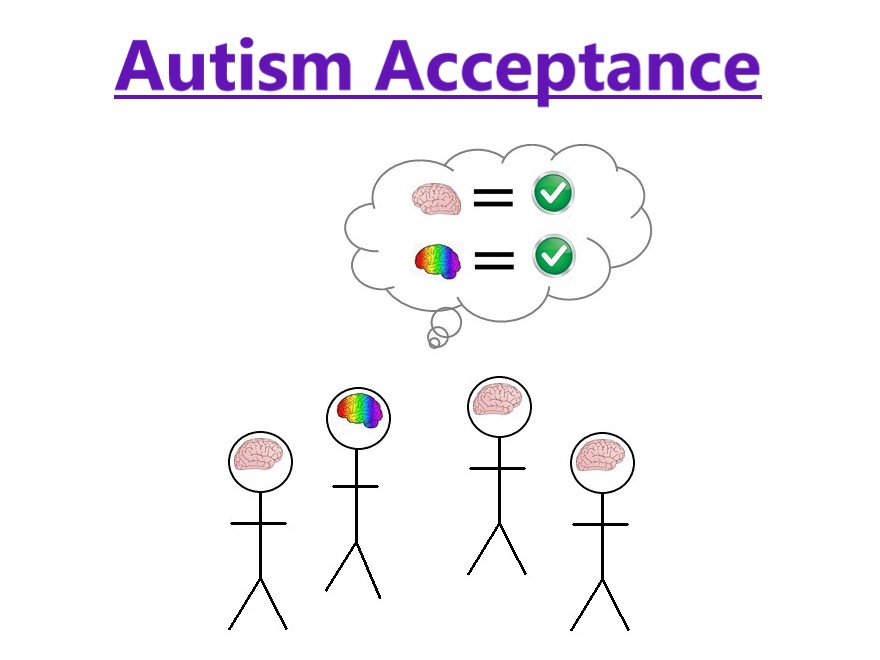
But there's nothing wrong with autistic mannerisms and there is no reason whatsoever why they should be suppressed. They're an aspect of what make us who we are. All humans have a unique combination of mannerisms; they're part of our identities.

I accept my mannerisms. I don't try to hide them because they are part of me and I have nothing to be ashamed of.

Embrace autistic mannerisms. Don't hide them. Allow yourself to be authentically you, autistic. You're âûsome!

Monday, 2 April 2018

Autism Acceptance Month 2018 Day 2: A is for Acceptance

British Sign Language: "accept"

This one may be slightly rushed as I've not got that much time (and I only came up with the alphabet idea on Friday night so I haven't had the opportunity to give it as much attention as I'd like!) Also, I'd rather keep the April posts more concise and shorter reading; when I have more time to work on things once this month is over, I can go into more depth and detail. This will not be comprehensive (lack of time today) so I will be writing more on this later.

There are so many possibilities for this letter! But as autistics are working to reclaim April for ourselves, are relabelling it Autism Acceptance Month and are pushing for us to be accepted and not merely tolerated, the most important A-word this month for me is:

A is for Acceptance

The word "awareness", particularly when it concerns a condition, generally implies that it is something inherently and exclusively bad. That it is something to be feared with the ultimate goal of eliminating it.

Acceptance moves beyond this, being included as we are, and this is what we are asking for. But what does it mean?

Making adjustments that allow us to access places, events, etc on an equitable basis as NTs. This could include things like non-fluorescent lighting, quiet spaces, ensuring only one sound at a time is going on (there are many accommodations, some of which will vary from person to person; a more detailed post on this will go up at some point in the future).

Remember and respect that our ability to cope with the world fluctuates, and just because we managed/appeared to manage perfectly well with a situation on one day, that does not automatically mean we can always cope with it. Tiredness, stress, anxiety, pain and many other factors influence and reduce our coping abilities, so if we tell you that we can't do that thing, please don't say, "But you were fine with it last month! Don't use autism as an excuse!" and try to pressure us into doing it. Respect that if we say we can't do something on a given occasion, even when we've done it before, we mean that. But also don't assume that means "I can't/won't do it ever again" unless we specifically say that; please do invite us again! It simply means "I can't do it on this particular occasion."

Allowing all forms of communication as equally valid as speech - AAC (Alternative and Augmented Communication), FC (Facilitated Communication), typing, writing, drawing, sign language, Makaton, PECS. This means not forcing speech (some autistics have apraxia, where for various reasons they physically cannot speak) at the cost of other options; this means giving the autistic person access to as many communication options as possible from an early age, and allowing them to use whichever is easiest and most comfortable for them (note: not what is easiest/most comfortable for the parent, teacher, etc). Speech is not the be-all and end-all; just look at the devastating effect forcing speech has had on Deaf people since the 1880 Milan conference. It's 2018 and Deaf people are still paying the price for that. Most of the time I am capable of speaking; however, when I am tired, stressed, etc, I can't, so let me communicate via writing or BSL, and don't pressure me to speak when I can't.

Respecting how the autistic person's brain operates and working with that. You wouldn't force a Mac computer programme to run on Windows or Linux (well, you could try, but you wouldn't get very far). The Mac/PC analogy is an old, well-used one, but it's a pretty good one. If an autistic person works best in a quiet, dimly-lit corner with a divider between them and other people, don't force them into the middle of the room under fluorescent lights surrounded with people and lots of different noises with no dividers.

Using the autistic person's preferred identifying language. If they prefer person-first language ("person with autism"/"has autism"), then use that when interacting with them. If, like the vast majority of autistics, they prefer identity-first language ("is autistic"), use that and don't language-police them (especially if you are NT) by insisting on PFL. Generally, with autistic preferences, either default to IFL or use both. "Autistic" is not a bad word and don't be afraid to use it!

Do not attempt to suppress autistic behaviours like stimming. If the behaviour is harmful (either to the person or to others), then redirect and try to encourage more constructive behaviours - for example, when I have a meltdown, I tend to hit things and scream (I will write more about meltdowns another time), which has the potential to cause damage (primarily to myself - so many bruises and bite-marks over the years). It still happens sometimes. Usually I can feel it building and have enough time to get somewhere safer while I still have some control, so I can direct myself to something like the bed or sofa, which can absorb the impacts and won't cause damage (either to me or whatever I'm hitting). There is nothing harmful about hand-flapping, bouncing, etc unless there is an underlying condition or a circumstance in which it would cause harm (for example, I have fibromyalgia, so if I do either of those too much, it causes excruciating joint pain). So what if an autistic bahves "unusually" (according to wider society) either in public or private? That's perfectly normal and often necessary for self-regulation or self-expression. Embrace it! If more autistics go ahead and do it in public without worrying about the reaction of other people, it will become much more normalised in society's mind and thus less noteworthy! I will happily behave autistically in public and if people stare, it's not my problem!

Following on from the previous paragraph, do not endorse, support or engage with "therapies" or "treatments" that are aimed at changing an autistic's behaviours purely to suit NT preferences and desires. The big one is ABA - its ultimate goal is to render the autistic "indistinguishable from their peers" and thus train them to suppress autistic traits in order to present as NT, in order to conform to society's preferences and comforts. Gay conversion therapy uses the same principles (reward and punishment). These approaches teach (explicitly or implicitly) that being autistic is A Bad Thing and cause lasting psychological damage; I have adult autistic friends who have PTSD from being put through ABA. If you're a parent new to the autism world, seek out autistics for guidance and advice - it can be a scary time and you are vulnerable to being preyed on.

This particularly includes what is going on at the Judge Rotenberg Center, with the electric-shock practices, using pain and fear to control people (autistics and those with various learning and developmental disabilities). You can read more on this link to the petition that was set up recently by Cal Montgomery, Kieran Rose (An Autistic Advocate) and myself. PLEASE sign and share it widely: FDA: End abusive electric shocks.

Learn how autistics communicate and adjust your approach accordingly. We communicate differently from NTs; some classic indicators (though not necessarily set in stone, especially by the time a person has reached adulthood) are bluntness, lack of eye contact, literality, precision, different body language. It's probably why I feel so at home in the Deaf community, as both types of mind are very similar! It is no bad thing for autistics to learn NT communication styles, as it helps us know what to look for and how things work, BUT communication goes two ways and any "social skills training" MUST also include teaching NTs how autistics communicate. Both styles are valid; they're just different.

Educating people about autism, without going down the fearmongering, tragedy-narrative, ableist route. If you see someone making a claim about autism that you know to be false, say something! I tend to be gentle and polite at first because people often don't realise; however, if it becomes clear that they're persisting with falsehoods, I do get more...belligerent!

Listening to and amplifying autistic voices over NTs. We are the experts; we live it in a way that no non-autistic person does. If we are telling you how things are, if something you are doing is hurting us, listen to that. Like with today, I am desperately saddened and frustrated by the number of parents insisting on doing Light It Up Blue and shouting down autistics who are telling them that this hurts us and explaining why, by denying the link between blue and Autism $peaks. If something you are doing hurts us and we tell you so, don't gaslight us. Don't invalidate us. Use this month to promote autistic writers, bloggers, artists, advocates, etc, not Martyr Parents like Judith Newman, Whitney Ellenby, etc, who seek to profit financially (through books, speaker fees, etc), emotionally and publicity-wise (attention-seeking, self-publicising, pity-seeking, etc). And call out people who try to silence autistic voices and promote the just-mentioned autism profiteers.

Presume competence. Being autistic does not mean treating us as though we have no ability to think for ourselves. We have agency, we have feelings, we have boundaries, we are human, we deserve as much respect as NTs.

**********

It's likely I've missed some things (as I said, rather pressed for time at the moment) but if I do think of something else that's pertinent, I will come back and edit this. And will be writing another, more all-encompassing post in the future when I have more time to read, think, organise, etc.

Wednesday, 1 November 2017

What do we want healthcare providers to know about autism, autistics and disability?

                                                   
This entry has been prompted by a post over on Autism Women's Network, where they have requested feedback and input in order to create a resource for healthcare providers on "[W]hat YOU wish your healthcare provider* knew about autism and treating autistics and disabled folks. 

 *Healthcare provider means anyone that's part of getting healthcare so doctors, nurses, reception/front desk, pharmacists, physical therapists, chiropractors, etc".

It's something I have previously thought about doing a blog post on, so now seems like an excellent time to do so!

*****

Here's what I hope is a fairly comprehensive list:
  • Give me everything in writing (a lot of us have trouble with information given to us solely through speech - processing and retaining) so I can re-read it if I can't remember something, if I need more time to process it to properly understand it, and so that I have something I can refer to at a later date. It's also useful to have it for the future, because communication is more difficult when we're ill, in pain, overloaded, etc, so articulating things is much more challenging; having something written down enables us to just hand it over for the other person to read. And I can give it to a family member/friend/whoever's with me.
  • Talk to me like an adult, not a baby - I am perfectly competent, and competence should be presumed (if a person is unable to comprehend or deal with something, they're likely to have a carer or support worker). Presume competence in nonspeaking autistics and disabled people, too. Also, unless the carer/support worker specifically states that you talk to them rather than the patient, talk to the patient! (This is part of the presuming-competence concept.)
  • Allow me enough time to process what has been said to me and to formulate a response. If I don't respond immediately, stay quiet and give me that time to think/process/formulate. If you interrupt me it will throw me off and I lose my thoughts and comprehension, so we'll have to start all over again, which I'm sure neither of us wants. If I need something repeated, I will say so.
  • Be patient if we are struggling to speak, don't talk over us or finish our sentences for us, and give as much time as we need to speak. Many autistics have difficulties with speech, including quite a few of my friends. For some people it's a muscle/brain co-ordination problem, for others it's anxiety- and stress-related. I'm generally OK on this front but when I'm tired, ill, stressed, in more pain than usual, have brain fog and/or am struggling with sensory overload, I do struggle with speech. Yes, it can be tempting to try to hurry us along, particularly if things are busy, but please afford us some respect. What we have to say is just as important as everyone else. If you attempt to hurry us, we feel under pressure, which causes stress, which exacerbates any speech issues, which turns into a downward spiral that distresses us - and you! - and could ultimately lead to a meltdown. Please don't guess what we're saying and speak over us or try to finish our sentences for us - it makes us feel undermined and not listened to. I've known some autistics to get so frustrated by this (not necessarily in a clinical setting; this happens in all walks of life) that they've just walked out. In a clinical setting it's really important that we are allowed to communicate everything, because that will help you to do your job to the best of your ability and help us as much as possible.
  • Alternative forms of communication are just as valid as speech. Not all autistics use speech, so treat my nonspeaking counterparts with just as much respect as you would a speaking autistic or an NT person. AAC, FC, etc are perfectly acceptable.
  • Provide us with a quiet, more-dimly-lit space. A lot of healthcare spaces (hospitals, pharmacies, clinics, etc) are unbearably bright because of white walls and fluorescent lights, and they can overwhelm us and be physically painful. The flickering of fluorescent lights is really distracting and uncomfortable, and the buzzing noise they make is irritating to the point where it can contribute to a meltdown, especially if everything else is a bit too much for us. Such places are usually busy, bustling with many people, which again can overwhelm us, and I find it even more so now I'm a wheelchair user, because everyone else is that much higher than me and I feel surrounded and trapped (and also it's more likely that people will inadvertently bump into me because their eyeline is much higher than my head). And if somewhere is busy, chances are there will be many different noises, which can be painful and overloading for us. I find that multiple noises tend to merge together in my ears and head to become one big, incomprehensible racket that's completely intolerable and can trigger a full meltdown. Please be mindful of backround noises, particularly music - a lot of it can be quite tinny and irritating for hypersensitive ears.
  • Ensure that toilets, especially disabled/accessible ones, are clearly marked and signposted, and kept in use and available whenever possible. Many disabled people have bladder and/or bowel issues, whether physiological or anxiety-related, so this is really important to us! And while I'm on that subject, please don't use the disabled toilet as a storage cupboard!!! It's less likely to happen in healthcare settings than elsewhere (pubs can be particularly bad for this) but it can and does occur. This is not acceptable, because unnecessary items take up space that can prohibit a wheelchair and/or a carer fitting into the toilet, thus rendering it inaccessible, which rather defeats the purpose of it. Additionally, please provide sanitary bins! The number of places that seem to forget that disabled women of childbearing age menstruate just like their able-bodied counterparts is staggering. When I did my MA, there was one toilet I used every week that never had a sanitary bin provided in it, despite my reporting the absence and requesting the provision of one every single week. On 3 separate occasions I had to leave a used tampon on the sink because there was nowhere else to put it; was I supposed to roll down the corridor with it on my lap to dispose of it in the inaccessible female toilets?! I really disliked having to do that but I had no other option.
  • Having a lower section for counters. So many clinical places have counters and desks that are level with my forehead and no lower option, which makes it quite difficult to effectively interact with people on the other side of it when you're a wheelchair user. It also makes it hard to exchange, sign, etc paperwork, especially when someone's ill because a lot of issues can affect people's ability to raise their arms. Mine certainly do.
  • Learn some basic signs. It makes a world of difference for Deaf people and quite a few autistics use sign language or Makaton as well. For me it would be BSL (British Sign Language) but obviously it depends where in the world you are. Having a chart with key signs by the desk is also a handy prompt, particularly if you don't use it very often. I've seen several shops with them here in Exeter and it would be brilliant if this became a standard thing.
  • Sometimes we struggle to identify our exact issue and the location of our issue. Many autistics have trouble pinpointing where there's something wrong or what it is. Please be patient with us and listen to what we are saying, but also I would encourage you to observe our bodies, how we move them, etc, because that can give you clues and information as to where the problem is. It can be helpful to ask about specific locations, such as, "Is the pain in your head? Is it in your left arm?" etc, or specific problems, eg, "Are things blurry? Do you feel sick?"
  • Be specific and precise, and as a general rule stick to literal, and avoid metaphorical, language. Clarity, specifics and precision are good for autistics, as well as other people with a variety of disabilities. Vagueness is difficult for us to understand and makes it hard to follow what your point is. It also makes us feel intellectually inferior because NT and autistic conventions are very different, so we may not grasp the meaning or conversation thread of intangible things.
  • Stimming is perfectly normal for us and intervention is only warranted if we are causing harm to ourselves/we are in danger. It's part of the autistic way, and however weird it may look to you and other people, there is nothing wrong with it, we may need to do it to regulate our body/our brain-body connection, to process sensations, to calm ourselves, to express emotions, to name some.
  • Sensory and physical health issues can be problematic when it comes to clinical involvement. Many of us are either hyper- or hypo-sensitive to touch and physiological input, so please check with us (when possible) before making physical contact with us. Many disabled people have difficulties with pain, muscle tightness or laxness, hypermobility or other physical dysfunctions. It's always best to check before touching, to prevent surprises, unnecessary pain, damage or violent reactions. I'm very hypersensitive to touch and because I have fibromyalgia, I have tender spots on my body where even a very light touch can cause me agony and physical manipulation of limbs is risky.

Thursday, 19 October 2017

Routines in everyday life

One of the most obvious signs of autism is the need for specific routines and structures, often for pretty much everything, however small, and when those routines get disrupted for whatever reason, everything after that goes horribly wrong. I have a specific structure and routine for everything I do in day-to-day life, and if that varies, things don't turn out so well. Some of these routines aren't an issue for NTs and if there's a slight difference from the usual way they do something, there are no problems. To NTs,  these are little things.

That's not the case for autistics.

In the evening, my husband and I have a cup of tea and watch an episode of something before bed. He has normal tea and I have peppermint tea. I've been drinking peppermint tea as a bedtime drink for almost 13 years now, so now my body takes it as a cue that it's time to mentally and physically start shutting down and preparing for sleep. The structure goes thus:
  1. Put water in kettle and turn kettle on
  2. Put out the two mugs side-by-side, his on the left, mine on the right
  3. Put normal teabag in his mug and peppermint teabag in mine (always the same mugs)
  4. Get two teaspoons out and place by the side of the mugs
  5. While kettle is boiling, check front door (it has to be manually locked; it's not an automatic lock) and put the chain across if it hasn't already been done (while we're very much in the habit of locking the door behind us once we're in, if we're distracted, such as desperately needing the toilet, it doesn't always happen)
  6. If kettle still hasn't boiled, tidy sink area
  7. When kettle has boiled, pour water into the mugs, Gideon's first, then mine
  8. When tea has brewed, remove teabags, put milk and sugar in Gideon's, and take through to the living room
It's quite a lot of steps when you break it down like that! I have a tendency to do that, probably from my days as an occupational therapy student (it's essential that OTs are able to do this, in order to identify the specific steps of the process with which a patient or service user has difficulty, and what that difficulty is), and also I need to for this particular blog post in order to demonstrate the autistic experience.

But sometimes that specific routine goes differently, and here are the outcomes from previous occasions when I've deviated from that precise structure:
  • Putting the mugs out before putting water in the kettle meant I forgot to turn the kettle on so wondered why, after a good ten minutes, I hadn't heard the kettle boil
  • Putting Gideon's mug on the right and mine on the left led to the normal teabag going in my mug and the peppermint one in his, which then led to me putting milk and sugar in the peppermint tea (not a pleasant taste!)
  • Using completely different mugs (the usual ones had been used by guests and had yet to be washed up) threw me so badly I didn't know whose mug was whose, although I was somewhat rescued from that because the Sainsbury's normal teabags are round and the Twining's peppermint teabags are rectangular, so I had the visual cue to work from, enabling me to rescue the situation
  • On one occasion I didn't check the front door while the kettle was heating up so we discovered the next morning that our door had been unlocked all night with no chain across - so anyone could have wandered in!
  • I've gone and checked the door before putting the teabags in the mugs, which led to there being no teabags when I poured water into the mugs, and because I'd been and checked the door, my body and brain assumed the teabags were in the mugs
  • Once I poured the water into my mug before Gideon's - and so I didn't pour any water into his mug! That one was rectified almost immediately, when I looked into the mug and realised the absence of water, but still, it happened
Another thing for which I need to follow the same routine every time is getting dressed. Because I'm fairly highly-educated (I have a Master's degree) people assume I don't have problems with what's known in the OT circle as ADL (Activities of Daily Living), but that routine is essential to me to ensure everything gets done.

My dressing routine goes thus:
  1. Underwear (bra then knickers)
  2. Top
  3. Trousers/skirt
  4. Socks (in summer I often forgo this step, as I tend to wear sandals)
  5. Jumper/hoodie/cardigan/etc
But if I put trousers or a skirt on before a top, I forget to put the top on. On several occasions I've moseyed around for a few minutes before realising my upper body is a bit cold, and only then does it dawn on me that I have no top on, just my bra! It's not such an issue if I notice before I wander into the kitchen, but if the blind is up in the kitchen, anyone glancing in gets a view of me in my underwear! It's also less of an issue now because the only person I live with is my husband; previously, I lived with one female now-ex-friend and one male friend, so my poor male housemate on several occasions nearly had the semi-topless view (I'm glad for his sake that this never happened; I noticed either before I got too far out of my room or it was on days when he was already out).

When I'm going out, if it's cooler/wet, I need to put my shoes on before a coat. Because if, as I discovered on Monday (perhaps "rediscovered" as I'm certain this isn't the first time it's happened; Monday is just fresh in my memory?), I put the coat on first, I will forget to put my shoes on. This leads to me being halfway to the car before realising I still have my slippers on! This is because the act of putting my coat on means my brain assumes I have already put my shoes on.

It's not just these two things; they're just two examples of my daily life and I could easily give many more! And it's not just me; this is standard for autistics.

When I get interrupted mid-routine, it really throws me. If I'm in the middle of certain activities, please let me see them through and don't interrupt me. Please let me finish. Please don't be offended or take it personally if I don't respond until I have finished that routine.

I used to refer to this as "ditziness"/"being a ditz" because it seemed to fit the meaning, but now I know I'm autistic, I've come to realise that it's because of this.

I do think there's an over-pathologising of autistic people's behaviours in some cases, but in this case it's definitely part of the autism.

The routines and structures are necessary to enable us to live our lives. They don't cause harm, they help us. Be respectful of that and accept that.

Sunday, 9 July 2017

Random autistic stuff

Just a quick Sunday-evening post because I was doing this with my Crispy M&Ms and I thought, "That's probably something to go on the autism blog". It's something I do constantly with anything that's a mix of colours (and always have done). M&Ms, Skittles, etc. and it is part of being autistic.

I like to know how many of each colour I have, then I work out which colour has the fewest, so I give eating priority to those of other colours that exceed the number of the colour with the fewest, so there's the same number of each colour. Then I'll eat either one or two of each colour so that by the time I've eaten one or two of the final colour there's still the same number of each colour.

It's partly a flavour thing when it comes to Skittles - orange is my least-favourite colour, so I eat all the orange ones first, then the blackcurrant ones, then one each of lemon and lime together, then finish with strawberry, which is my favourite. With M&Ms flavour isn't an issue, but I still go for the orange ones first, then the brown ones, then usually red, yellow, green and finally blue (though for some reason today I did it the other way round - I don't know why and now it's bugging me). If I'm in a situation where I can't count them, line them up and so on it does stress me out. That situation's most likely to occur when I'm driving, although as Gideon doesn't particularly like Crispy M&Ms we don't tend to get them, so that scenario doesn't come up very often. If I'm munching on them while driving alone, I just have to grit my teeth and put up with it because there's not much I can do.

On its own it's not a harmful behaviour so I'm not going to do it just because it's considered a bit "odd" or in order to seem NT or anything like that - I don't modify my behaviour in order to "pass" as NT because I am autistic and don't want to be anything else. However, I'm far more likely to engage in it rigidly and inflexibly when I'm stressed, so if I'm being really strict about it, it's usually an indicator that something is off and that I need to watch myself in case my other OCD behaviours kick in, behaviours that can cause actual problems.