Showing posts with label accommodations. Show all posts

Thursday, 5 April 2018

Autism Acceptance Month 2018 Day 5: D is for Diagnosis

BSL: diagnosis

D is for Diagnosis

Getting diagnosed as autistic can be extremely positive for many. The process can be long, hard and slow, but once the point of formal diagnosis is reached, it can be a massive relief. And this is why I am marking "diagnosis" as autism-positive and as part of acceptance.

For parents of children, getting a formal diagnosis can be a tumult of emotions, some positive and some negative. From the various autistics-and-families groups I'm in on Facebook, the positives of having a diagnosis tend to centre around having confirmation and validation of their child's neurology and difficulties, knowledge that they have not been bad parents and access to supports (potentially - it can often be a bit of a postcode lottery!) that can only be obtained with formal diagnosis, such as equipment, support in school and so on. Additionally, it can help them understand their child better (depending on where they look, what they read, etc).

For people like me, who grew up not knowing they were autistic, diagnosis again can cause a mix of good and bad emotions. I've noticed, though, that feelings tend to be overwhelmingly positive, especially for those who have been trying for a long time to get a diagnosis. I spent several years in the self-diagnosed camp because trying to get an assessment as an adult in the UK is difficult; in 2009-10 there was nothing in my parents' area of Essex (I am not an Essex girl; I was born in Hertfordshire but raised by a Lancashire woman so I am firmly a Lancashire lass) for assessing adults, and it wasn't until 2011 that an adult assessment service was set up in the Exeter area. For me, getting that formal diagnosis was 100% positive.

Upon receiving a formal diagnosis, the feelings I and many other adult-diagnosed autistics experienced were a combination of joy, relief and validation. Some do experience negative feelings, such as confusion, anger, frustration and fear - things like, "Why was I not picked up sooner as autistic?", "What does this mean for my future?", "Will it make my life more difficult?", "Will people reject me?" and "I don't want to be autistic" (partly because of the persistently and wholly negative portrayal of autism), to name some. These are perfectly valid responses, particularly in a world that tend to be hostile, overwhelming and confusing to autistics. This is why we need proper acceptance.

Why so positive?

Knowing that your brain is not defective or broken, that it is simply wired differently, can be a massive relief. I was 23 or 24 when I self-diagnosed and 28 when I was formally diagnosed. When a friend suggested to me that I might be autistic, I looked into it and comprehension dawned, everything clicked into place and you know in cartoons when someone has an inspiration, a lightbulb lights up over their head? I could practically see that! For a long time I had genuinely believed my brain and myself to be broken, because I struggled socially, my bluntness was often perceived as rudeness, I was hypersensitive to everything, I was often considered weird and awkward, and things that came instinctively to others (eg. comforting a crying classmate) were very difficult and unnatural to me and were very intellectualised. Once I realised that there was nothing wrong with me, that everything could be explained, I was a lot kinder to myself. And that brings a real sense of peace and self-acceptance.

Once I knew I was autistic, I indulged my inner Hermione and read as much about autism as I could get my hands on! I wanted (and still want) to know everything about autism. And in reading things about it and interacting with other autistics, I came to understand myself so much better than I had previously done. And that's a massive self-esteem boost.

Validation is a powerful thing. I respect that some people do not want to seek a formal diagnosis and they have their reasons. It's something that is currently being researched at Exeter University in the Exploring Diagnosis project, for which I am an advisor on one of the PhD projects. If anyone in the UK is reading this, sought diagnosis as an adult or chose to remain solely self-diagnosed, and would be interested in participating as an interviewee, do let me know and I can put you in contact with the relevant people! For me, being only self-diagnosed was not enough - I found myself frequently questioning and doubting whether I was actually autistic, and wondering if it was mental-health problems masquerading as autistic signs (turns out the mental-health problems were largely a result of difficulties from not realising I was autistic!) In addition, I encountered a number of people who did not see self-diagnosis as valid and I got rather fed up of trying to justify myself to them. Getting a formal diagnosis, for me, silenced the doubters (including myself!) and, more importantly for me, confirmed and validated that my difficulties (and also things I have come to see as strengths) were real, that my experience of the world and how I processed it were true and not some figment of my vivid imagination, and that I was definitely autistic.

As well as this, when I lend my voice to campaigns such as Not Locked In (last year) and the ongoing Judge Rotenberg Center campaign with Cal Montgomery and Kieran Rose, having a formal diagnosis gives more weight to my voice than if I were only self-diagnosed, and means it is more likely (not guaranteed by any means, because people like to throw functioning labels around by claiming that I'm "too high-functioning" to advocate for "low-functioning" (their words, not mine) and the "Not Like My Child" card (of course I'm not like your child - they're 6 or whatever and I'm 33!)) that my voice will be listened to, because I am considered a "genuine" autistic. I wish that self-diagnosed autistics were afforded the same level of value as those of us who are formally diagnosed, but that is not currently the case.

Having that formal diagnosis has given me so much confidence to be authentically me. I don't hide my stimming, I'm open about not making eye contact and why, and it means that I don't hide my autism generally. When I go for job interviews (rare, because my physical disabilities significantly restrict how much I can do, and because I'm autistic certain environments are unworkable for me), I can inform them beforehand that because I am autistic, I will not be making eye contact due to the physical pain it causes me. I am autistic and proud to be so!

As I said in yesterday's post, C is for Community, getting that diagnosis has helped me feel more part of the autistic community than when I was only self-diagnosed, due to the validation and confidence explained above. And I've made some amazing friends there. I'll talk more about that later this month in S is for Social Media.

In getting a diagnosis, I now know that I am not alone, that there are many people out there who are like me and who understand me. And that's such a positive thing! There are people out there who are like me; I'm not some sort of broken freak of nature!

Being formally diagnosed can (not necessarily, as it depends on people and what's available in your local area) enable you to access to (appropriate) supports and accommodations that you may not be able to access without a formal diagnosis, such as support in education, assistive technology, therapists trained and/or specialising in working with autistics, and so on. Many places will only consider those with a formal diagnosis, possibly due to limited resources, the risk of doing harm with an unsuitable approach or for insurance purposes (more in the US than in the UK), for example. While such things are meant to be based on needs rather than diagnosis, having a formal diagnosis can make the process easier and quicker. Also, knowing that you are autistic can make it easier to determine particular techniques that work for us but not necessarily NTs and vice versa.

Diagnosis is today's word because for me, getting a formal diagnosis has been immensely positive and has enabled me to accept and be confident in my being autistic.


Monday, 2 April 2018

Autism Acceptance Month 2018 Day 2: A is for Acceptance

British Sign Language: "accept"

This one may be slightly rushed as I've not got that much time (and I only came up with the alphabet idea on Friday night so I haven't had the opportunity to give it as much attention as I'd like!) Also, I'd rather keep the April posts more concise and shorter reading; when I have more time to work on things once this month is over, I can go into more depth and detail. This will not be comprehensive (lack of time today) so I will be writing more on this later.

There are so many possibilities for this letter! But as autistics are working to reclaim April for ourselves, are relabelling it Autism Acceptance Month and are pushing for us to be accepted and not merely tolerated, the most important A-word this month for me is:

A is for Acceptance

The word "awareness", particularly when it concerns a condition, generally implies that it is something inherently and exclusively bad. That it is something to be feared with the ultimate goal of eliminating it.

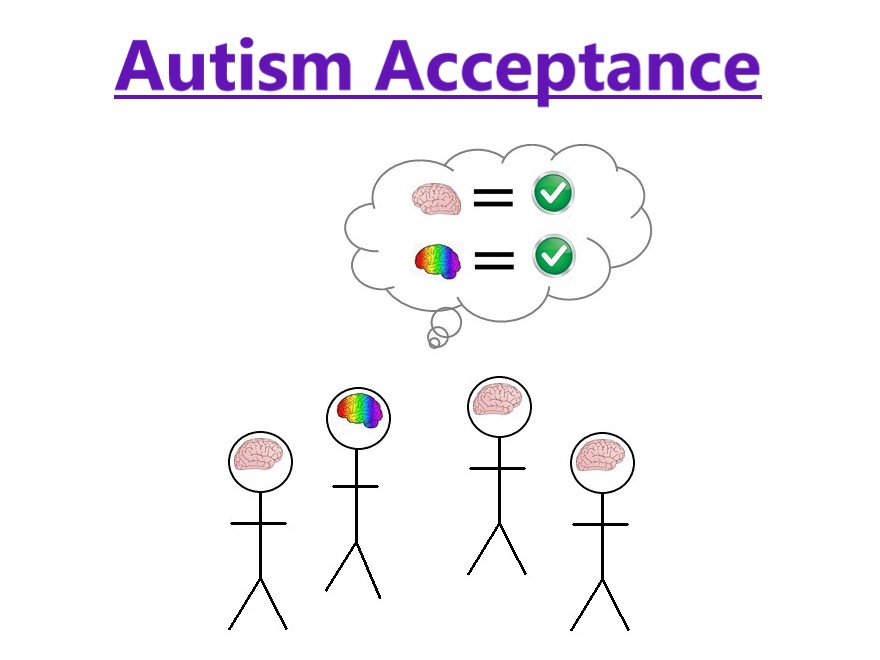
Acceptance moves beyond this, being included as we are, and this is what we are asking for. But what does it mean?

Making adjustments that allow us to access places, events, etc on an equitable basis as NTs. This could include things like non-fluorescent lighting, quiet spaces, ensuring only one sound at a time is going on (there are many accommodations, some of which will vary from person to person; a more detailed post on this will go up at some point in the future).

Remember and respect that our ability to cope with the world fluctuates, and just because we managed/appeared to manage perfectly well with a situation on one day, that does not automatically mean we can always cope with it. Tiredness, stress, anxiety, pain and many other factors influence and reduce our coping abilities, so if we tell you that we can't do that thing, please don't say, "But you were fine with it last month! Don't use autism as an excuse!" and try to pressure us into doing it. Respect that if we say we can't do something on a given occasion, even when we've done it before, we mean that. But also don't assume that means "I can't/won't do it ever again" unless we specifically say that; please do invite us again! It simply means "I can't do it on this particular occasion."

Allowing all forms of communication as equally valid as speech - AAC (Alternative and Augmented Communication), FC (Facilitated Communication), typing, writing, drawing, sign language, Makaton, PECS. This means not forcing speech (some autistics have apraxia, where for various reasons they physically cannot speak) at the cost of other options; this means giving the autistic person access to as many communication options as possible from an early age, and allowing them to use whichever is easiest and most comfortable for them (note: not what is easiest/most comfortable for the parent, teacher, etc). Speech is not the be-all and end-all; just look at the devastating effect forcing speech has had on Deaf people since the 1880 Milan conference. It's 2018 and Deaf people are still paying the price for that. Most of the time I am capable of speaking; however, when I am tired, stressed, etc, I can't, so let me communicate via writing or BSL, and don't pressure me to speak when I can't.

Respecting how the autistic person's brain operates and working with that. You wouldn't force a Mac computer programme to run on Windows or Linux (well, you could try, but you wouldn't get very far). The Mac/PC analogy is an old, well-used one, but it's a pretty good one. If an autistic person works best in a quiet, dimly-lit corner with a divider between them and other people, don't force them into the middle of the room under fluorescent lights surrounded with people and lots of different noises with no dividers.

Using the autistic person's preferred identifying language. If they prefer person-first language ("person with autism"/"has autism"), then use that when interacting with them. If, like the vast majority of autistics, they prefer identity-first language ("is autistic"), use that and don't language-police them (especially if you are NT) by insisting on PFL. Generally, with autistic preferences, either default to IFL or use both. "Autistic" is not a bad word and don't be afraid to use it!

Do not attempt to suppress autistic behaviours like stimming. If the behaviour is harmful (either to the person or to others), then redirect and try to encourage more constructive behaviours - for example, when I have a meltdown, I tend to hit things and scream (I will write more about meltdowns another time), which has the potential to cause damage (primarily to myself - so many bruises and bite-marks over the years). It still happens sometimes. Usually I can feel it building and have enough time to get somewhere safer while I still have some control, so I can direct myself to something like the bed or sofa, which can absorb the impacts and won't cause damage (either to me or whatever I'm hitting). There is nothing harmful about hand-flapping, bouncing, etc unless there is an underlying condition or a circumstance in which it would cause harm (for example, I have fibromyalgia, so if I do either of those too much, it causes excruciating joint pain). So what if an autistic bahves "unusually" (according to wider society) either in public or private? That's perfectly normal and often necessary for self-regulation or self-expression. Embrace it! If more autistics go ahead and do it in public without worrying about the reaction of other people, it will become much more normalised in society's mind and thus less noteworthy! I will happily behave autistically in public and if people stare, it's not my problem!

Following on from the previous paragraph, do not endorse, support or engage with "therapies" or "treatments" that are aimed at changing an autistic's behaviours purely to suit NT preferences and desires. The big one is ABA - its ultimate goal is to render the autistic "indistinguishable from their peers" and thus train them to suppress autistic traits in order to present as NT, in order to conform to society's preferences and comforts. Gay conversion therapy uses the same principles (reward and punishment). These approaches teach (explicitly or implicitly) that being autistic is A Bad Thing and cause lasting psychological damage; I have adult autistic friends who have PTSD from being put through ABA. If you're a parent new to the autism world, seek out autistics for guidance and advice - it can be a scary time and you are vulnerable to being preyed on.

This particularly includes what is going on at the Judge Rotenberg Center, with the electric-shock practices, using pain and fear to control people (autistics and those with various learning and developmental disabilities). You can read more on this link to the petition that was set up recently by Cal Montgomery, Kieran Rose (An Autistic Advocate) and myself. PLEASE sign and share it widely: FDA: End abusive electric shocks.

Learn how autistics communicate and adjust your approach accordingly. We communicate differently from NTs; some classic indicators (though not necessarily set in stone, especially by the time a person has reached adulthood) are bluntness, lack of eye contact, literality, precision, different body language. It's probably why I feel so at home in the Deaf community, as both types of mind are very similar! It is no bad thing for autistics to learn NT communication styles, as it helps us know what to look for and how things work, BUT communication goes two ways and any "social skills training" MUST also include teaching NTs how autistics communicate. Both styles are valid; they're just different.

Educating people about autism, without going down the fearmongering, tragedy-narrative, ableist route. If you see someone making a claim about autism that you know to be false, say something! I tend to be gentle and polite at first because people often don't realise; however, if it becomes clear that they're persisting with falsehoods, I do get more...belligerent!

Listening to and amplifying autistic voices over NTs. We are the experts; we live it in a way that no non-autistic person does. If we are telling you how things are, if something you are doing is hurting us, listen to that. Like with today, I am desperately saddened and frustrated by the number of parents insisting on doing Light It Up Blue and shouting down autistics who are telling them that this hurts us and explaining why, by denying the link between blue and Autism $peaks. If something you are doing hurts us and we tell you so, don't gaslight us. Don't invalidate us. Use this month to promote autistic writers, bloggers, artists, advocates, etc, not Martyr Parents like Judith Newman, Whitney Ellenby, etc, who seek to profit financially (through books, speaker fees, etc), emotionally and publicity-wise (attention-seeking, self-publicising, pity-seeking, etc). And call out people who try to silence autistic voices and promote the just-mentioned autism profiteers.

Presume competence. Being autistic does not mean treating us as though we have no ability to think for ourselves. We have agency, we have feelings, we have boundaries, we are human, we deserve as much respect as NTs.

**********

It's likely I've missed some things (as I said, rather pressed for time at the moment) but if I do think of something else that's pertinent, I will come back and edit this. And will be writing another, more all-encompassing post in the future when I have more time to read, think, organise, etc.